Tell us about the job
Takes about a minute. No obligation.
A furnace repair in Brown County starts with what the system has already been asked to carry. 135 severe weather events were recorded in Brown County, Wisconsin between 2015 and 2024. At that rate, severe weather is a standing feature of the operating environment, and heat exchangers, igniters, and blower motors here accumulate stress across season after season of hard cycling. A contractor working a repair in this area checks those components early, because the load the weather puts on them is real and shows up in the parts. Age and maintenance history still decide most of what they find, but the weather record here means neither factor gets to work in easy conditions.
Ductwork that has served the same house through several furnace lifetimes carries its own history: bent takeoffs, resealed joints, and heat exchangers that have been patched by whoever came before. Half the homes in Brown County, Wisconsin were built in 1981 or earlier (2020-2024 ACS 5-year). When a licensed contractor opens a furnace in a house from that era, the repair scope often turns on whether the parts the system takes are still in production, and a unit far enough along in its service life may have components that have quietly moved to special-order status. That is the variable that shapes the repair bill here, and it is not always visible until the cabinet is open.
The Parts of a Furnace a Contractor Checks First
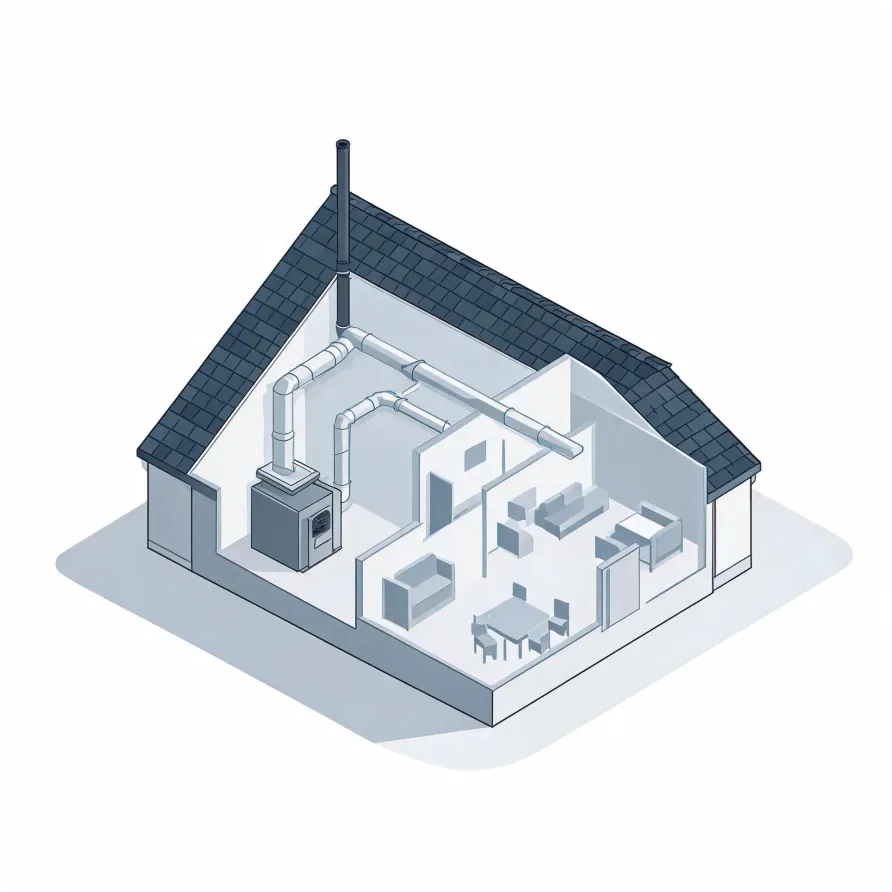
The furnace itself sits in the basement, utility room, or garage and is the piece that produces heat. Inside it, the heat exchanger is what a contractor looks at closely when something smells wrong or the system short-cycles. The burners, which fire inside that exchanger, are checked when heat output drops or ignition becomes unreliable.
The blower motor moves conditioned air out of the furnace cabinet and into the supply side of the house. Beside it, the control board coordinates every other component, and a fault there can mimic failures elsewhere in the system. The flue pipe exits the cabinet and vents combustion gases outside, and its condition tells a contractor a lot about how the furnace has been running.
The drawing shows a general layout of these components, and a licensed contractor will determine what applies to your specific system and home.
Get matched in Brown CountyBrown County, Wisconsin, by the numbers
135 severe weather events were recorded in Brown County, Wisconsin between 2015 and 2024.
NOAA National Centers for Environmental Information, Storm Events Database, bulk CSV export, events 2015-01-01 through 2024-12-31.Half the homes in Brown County, Wisconsin were built in 1981 or earlier (2020-2024 ACS 5-year).
U.S. Census Bureau, 2020-2024 American Community Survey 5-Year EstimatesBrown County, Wisconsin holds 115,493 housing units (2020-2024 ACS 5-year).
U.S. Census Bureau, 2020-2024 American Community Survey 5-Year EstimatesOwners occupy 66.0% of the occupied homes in Brown County, Wisconsin (2020-2024 ACS 5-year).
U.S. Census Bureau, 2020-2024 American Community Survey 5-Year EstimatesFurnace Repair Rules That Apply in Brown County, Wisconsin6 codes, standards & laws
What the Repair Visit Looks Like
Non-weatherized gas furnaces manufactured on or after November 19, 2015 must reach 80.0 percent AFUE.
Non-weatherized oil-fired furnaces manufactured on or after November 19, 2015 must reach 83.0 percent AFUE.
Mobile home gas furnaces manufactured on or after November 19, 2015 must reach 80.0 percent AFUE.
Non-weatherized gas furnaces manufactured on or after December 18, 2028 must reach 95.0 percent AFUE, up from the 80.0 percent minimum that applies to units manufactured before that date.
Licensing and Legal Requirements for HVAC Repair in Brown County, Wisconsin
A Wisconsin business that employs a certified HVAC qualifier is a certified HVAC business, and no city or county may require it to hold a local certification or licence on top of that.
Wisconsin requires a state HVAC contractor registration: no person or business may install or service heating, ventilating or air conditioning equipment, or offer to, without one.
Severe Weather Events in Brown County
Brown County weather puts real load on furnace components. Repair needs here are shaped by local conditions, and that makes the service a local question.
135 severe weather events, 2015–2024. Source: NOAA National Centers for Environmental Information, Storm Events Database.